Co-founder of Purposeful Relations Stuart Bruce spoke at a PRCA South West session, discussing AI as a reputational stakeholder in its own right. The session also explored how LLMs form their view of an organisation, why earned media and credible third-party voices shape what AI says about you, the reputational risks when AI gets it wrong, and how you can monitor, measure, and influence your organisation’s standing in AI-generated answers.
Reputation has always been a huge factor in what others say about you – through multiple channels such as journalists, customers, employees, and investors. Now, a new powerful voice has emerged, and it speaks to your audiences every day.
Today, potential consumers will ask AI to help them, and what it says about whether a company can be trusted and how it compares with competitors will become their first impression and a reputation verdict rolled into one, forming the consumer’s opinion with the organisation concerned often being unaware of what is said.
The PRCA summarised Stuart’s presentation in a LinkedIn post.
“Stuart… explained that simply measuring how often an organisation appears in AI answers doesn’t tell us whether those appearances are accurate, useful or reputationally positive.
There’s also a fundamental measurement challenge, as PRs don’t have access to the underlying prompt data from AI companies in the same way that we have datasets for areas such as search, social listening or media monitoring.
Our conclusion? AI measurement should be considered directional, rather than absolute truth.
Stuart’s advice was not to rely on the output of a single GEO measurement tool as definitive. Using multiple tools alongside expert human analysis can provide a stronger basis for decision-making.
For communications professionals, the principle is familiar: don’t measure something simply because it’s easy to put on a dashboard. Measure what actually matters.”
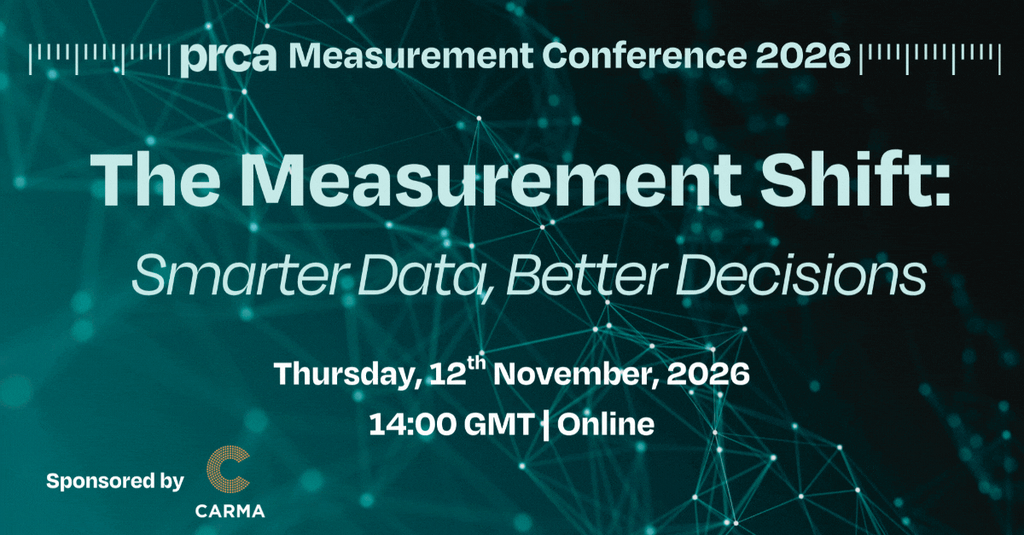
Purposeful Relations CEO Stuart Bruce will be one of the speakers at the 2026 PRCA Measurement Conference on Thursday 12 November.
This year, the conference will explore how measurement is moving beyond retrospective reporting to supporting planning, prediction, and decision-making.
Through practical case studies, industry discussion, and expert presentations attendees will be able to examine how to assess the quality of communications data, understanding emerging forms of AI-driven influence, establish meaningful measures and translate evidence into strategic and behavioural value.
Stuart Bruce will appear alongside Allison Spray, EMEA Chief Data & Intelligence Officer, Burson; Jonny Bentwood, Chief Data & Analytics Officer, Golin Ketchum; Anna Wilson, Chief Innovation Officer, Tangerine; and Sanjiv Winayak, Senior Client Director & Head of AI, Milk & Honey. They will discuss Visibility to influence – Measuring PR in the AI Discovery Era.
Led by the PRCA Innovation Working Group, this panel will explore how approaches to GEO and AI visibility measurement are developing, which measures provide useful insight where greater consistency and shared standards are still needed.
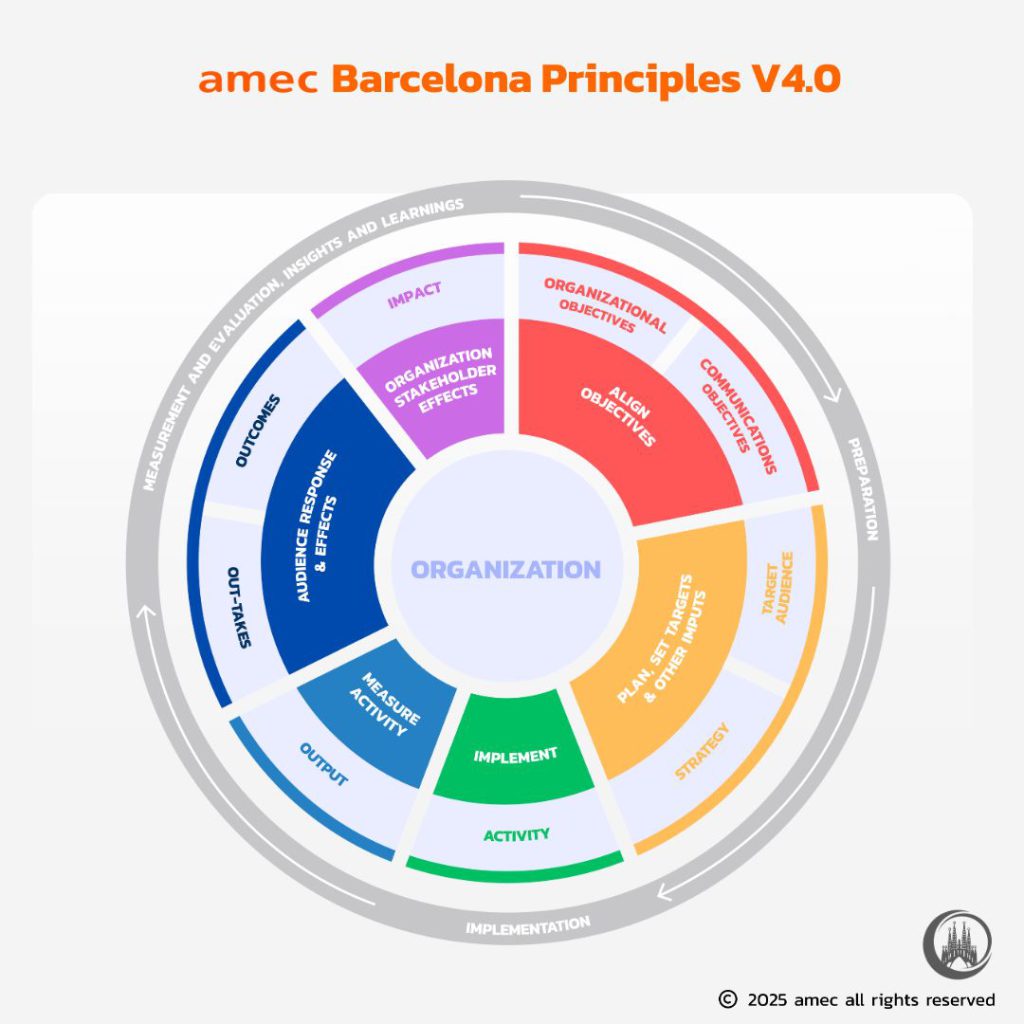
The Barcelona Principles 4.0 are an evolution, not a revolution. The updated principles were launched on the first day of the AMEC global summit in Vienna.
Both of Purposeful Relations’ founders were in Vienna for the launch and were able to chat to some members of the working group so they could better understand the changes.
Barcelona Principles 4.0
Setting clear, measurable objectives is a critical prerequisite for effective communication planning, measurement and evaluation.
Defining and understanding all stakeholder audiences are essential steps to plan, build relationships and create lasting impact.
Comprehensive communication measurement and evaluation should be applied to all relevant channels used to understand and influence audience stakeholders.
Effective measurement and evaluation of communication require qualitative and quantitative analysis.
Invalid measures such as advertising value equivalents (AVEs) should not be used. Instead measure and evaluate the contribution of communication by its outcome and impact.
Measurement and Evaluation Should report outputs, outcomes, and impact related to the organization and stakeholder audiences.
Ethics, governance and transparency with data, methodologies and technology builds trust and drives learning.
Barcelona Principles 4.0 are an evolution, not a revolution
Members of the Barcelona Principles 4.0 working group on stage to launch the update
The fourth iteration of the Barcelona Principles are an evolution, not a revolution. The biggest change to the PR and communications industry since the last principles is undoubtedly the rapid emergence and importance of AI. Some of the language in the principles has been “sharpened” to reflect this.
The main thematic changes are:
Providing a clearer link and relationship between the principles and the AMEC Integrated Evaluation Framework (IEF), which shows how they can be applied.
The principles are now colour coded to show which part of the IEF they link to, along with an updated Barcelona Principles and Integrated Evaluation Framework infographic.
The updated principles are explained in an ebook.
Increased emphasis on explaining that while outcomes are the most important, measuring outputs is still important.
AMEC has also followed the lead of the UK’s Government Communication Service, which last year updated its own measurement and evaluation framework to become The Evaluation Cycle. The updated principles now put more focus on continuous iteration, improvement, and constant learning.
Barcelona Principles 4 ebook
The Barcelona Principles 4.0 ebook explains each of the seven principles in four steps.
Why it matters – a simple explanation of why the principle is important.
Why it has evolved – showing the previous three versions and explaining why it has changed.
What to do – tips for how to put the principle into practice.
What not to do – identifying common mistakes that need to be avoided.
The AMEC Summit 2023 was in Miami from 15-17 May and as a first-time attendee I want to share some of my impressions and experiences from what was an informative and very friendly event.
There were many great sessions, and it feels unfair to only talk about a few, but these were some of my particular favourites.
Distinguished Professor Jim Macnamara, PhD, FAMI, CPM, FAMEC, Professor of Public Communication, School of Communication by Learnings from Three Years Leading Evaluation of WHO Communication During COVID-1
Jim Macnamara provided thought provoking insight into the use of measurement and evaluation frameworks. Using his work with the World Health Organisation (WHO) during the COVID pandemic, he made the compelling case that we should use the label measurement, evaluation and learning (MEL) as the correct way to describe this activity. Just calling the work measurement and evaluation suggests that it is a retrospective technique, and by including learning we go beyond reportage and provide insights to adjust our strategy in real time. The WHO document is publicly available and an excellent read.
AI Ethics: access to implementation by John Murphy, Assistant Professor-in-Residence, Digital Media & Design, University of Connecticut.
AI was addressed in several presentations and panel sessions at the AMEC Summit, but John Murphy’s session was to my mind the most thought provoking and therefore most interesting. His thesis was that as communicators we need to put the ethics of AI and the data it utilises at the centre of our everyday practice. That AI does not think about humans when creating outputs was one of the more important realisations. It is therefore important, that unlike social media, there is a level of legislative and regulatory control over AI control. The technology must be used for the betterment of humans as it has the potential to cause great harm.
A value point of view: looking beyond your own reflection by Katie Paine, CEO, Paine Publishing.
Katie Paine presented an excellent piece of analysis that showed how so-called vanity metrics can be correlated with other user actions. Using a unique visit to a website as the desired outcome for a campaign, Katie scored a series of other actions that the user had undertaken in social and traditional media to see which correlated with the desired action.
The top positive correlation was neutral social mentions, followed by activity with traditional media and LinkedIn. The largest negative correlation was (unsurprisingly) making a negative comment, followed by activity on Twitter and Facebook. The work required several data sources to be ‘braided’ together to provide this level of insight. Better data literacy and management was a topic that appeared a number of times across the conference programme.
One of these presentations was from Stella Bayles of CoverageBook. Stella presented the results of a survey she had commissioned at the end of 2022 looking at how PR practitioners use data in their practise. There were some insightful statistics: 68% of PR practitioners said they had no one who filled the role of data expert whom they could consult and 98% had no external measurement team to talk with. More than half (57%) of PR agency and freelance practitioners said they lacked confidence in their own data skills.
At Purposeful Relations we help some of our clients with PR training to help them understand and use data more effectively. We can also act as that ‘external measurement team‘ to provide expert guidance and support on more challenging data issues.
This is disappointing though not unexpected, and it will take a concerted effort to integrate measurement and evaluation into day-to-day practise. Stella cited examples of where organisations had developed their companywide data capabilities. This included hiring data experts, it also development of the data skills of all staff. The good news is that new entrants to the profession seem far more comfortable with data that many existing practitioners.
The final session at the AMEC Summit wasJulia Petryk, Head of PR, MacPaw, who spoke about the massive impact of the Russian invasion on Ukraine and how as well as keeping the world leading MacPaw running smoothly, she had co-founded the Ukrainian PR army. This group of volunteers spends their time reminding the world of what is going on in Ukraine. As you would expect, it was a compelling and at times very emotional presentation and Julia rightly received a standing ovation at the end.
AMEC Summit 2024 in Sofia
As a first-time attendee the most striking aspect of the AMEC Summit was the networking. Sometimes a little awkward (on my part) I felt welcomed into the AMEC family and I want to give a big thanks to Johna Burke AMEC Global Managing Director and her team for the excellent organisation and Aseem Sood, AMEC Chair who along with the board provided their leadership. I’m looking forward meeting everybody again in Sofia at the AMEC Summit 2024.
Manage Consent
To provide the best experiences, we use technologies like cookies to store and/or access device information. Consenting to these technologies will allow us to process data such as browsing behavior or unique IDs on this site. Not consenting or withdrawing consent, may adversely affect certain features and functions.
Functional
Always active
The technical storage or access is strictly necessary for the legitimate purpose of enabling the use of a specific service explicitly requested by the subscriber or user, or for the sole purpose of carrying out the transmission of a communication over an electronic communications network.
Preferences
The technical storage or access is necessary for the legitimate purpose of storing preferences that are not requested by the subscriber or user.
Statistics
The technical storage or access that is used exclusively for statistical purposes.The technical storage or access that is used exclusively for anonymous statistical purposes. Without a subpoena, voluntary compliance on the part of your Internet Service Provider, or additional records from a third party, information stored or retrieved for this purpose alone cannot usually be used to identify you.
Marketing
The technical storage or access is required to create user profiles to send advertising, or to track the user on a website or across several websites for similar marketing purposes.